
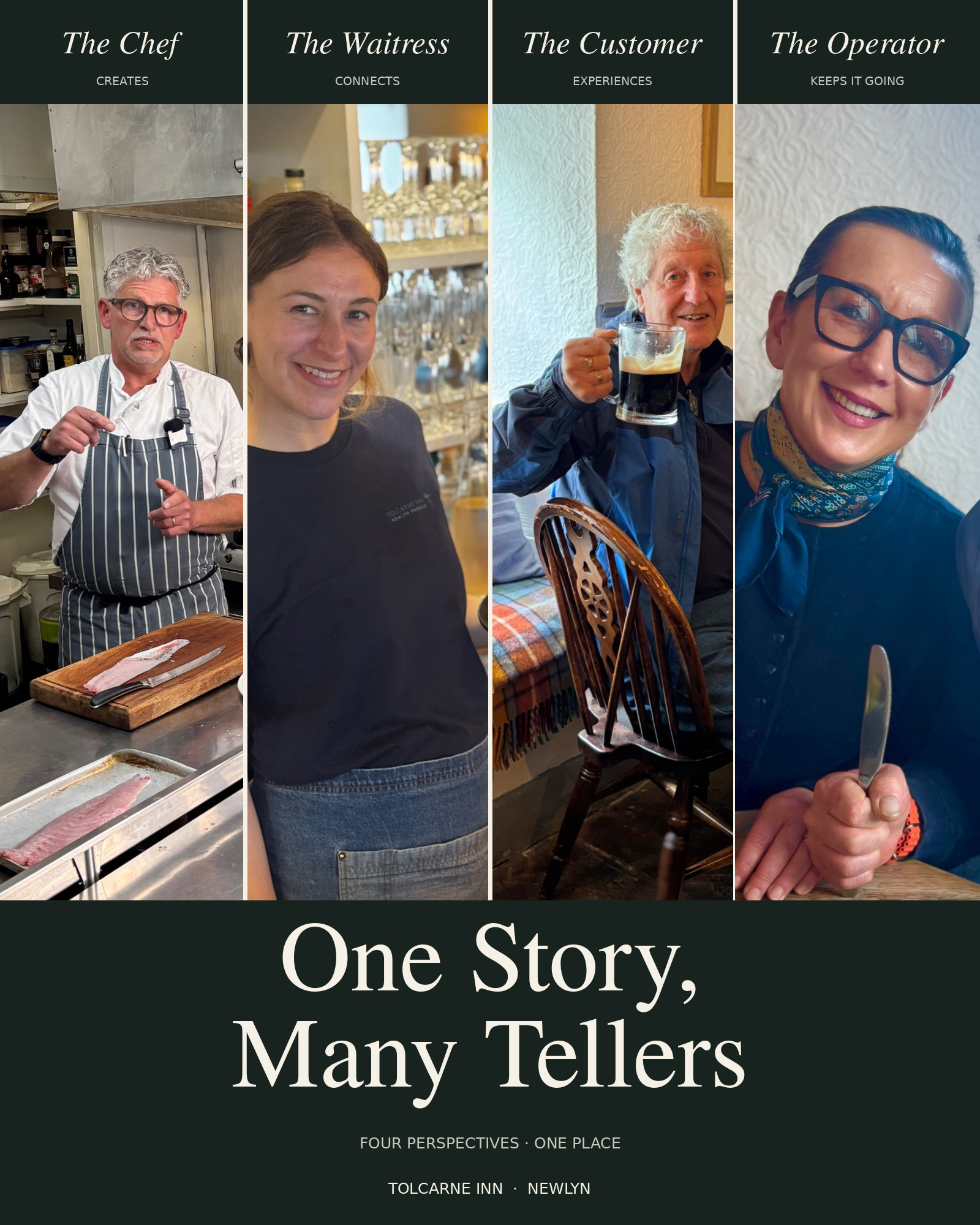
One Story, Many Tellers
Hospitality is a performance.
Hospitality is a performance.
At Tolcarne, we perform twice a day, most days.
The audience arrives for lunch and dinner, but preparations start long before anyone walks through the door. By then, the floors have been cleaned, tables laid, glasses polished, deliveries unpacked and the kitchen has been working for hours.
At least, that’s the plan.
There is always a clock involved.
Staff need to arrive on time, deliveries preferably before we need what is inside them, and lunch has an inconvenient habit of starting at exactly the advertised hour whether we are ready or not.
I have always believed that staff should help clean the place they work in. Partly because somebody has to, but mostly because it’s difficult to take pride in a stage you haven’t helped prepare.
And pride matters.
By lunchtime, none of this should be visible.
The door opens and the first customer arrives.
Smile.
Ideally, a genuine one.
A genuine smile is relatively easy when you’re waiting for your first table. Producing exactly the same one when the restaurant is full, the phone is ringing and three people need you simultaneously is where hospitality gets interesting.
The customer has only just arrived.
They don’t know what sort of morning we’ve had.
And really, why should they?
Hello, welcome, have you got a reservation?
Simple enough.
Unless you’re sixteen, it’s your first job, and you’ve just been asked to walk up to a complete stranger and behave as though you’ve been doing this all your life.
Hospitality asks people to become comfortable with strangers remarkably quickly.
When I train inexperienced staff, I give them two pieces of advice.
The first is to use what I call a running commentary.
Let me take you to your table.
I’ll bring some water over.
I’ll just find that out for you.
It sounds ridiculously simple, but it works. Approaching strangers can be awkward, particularly when you’re young. Talking about what you’re doing gives you something to say until eventually you no longer need to think about what to say.
The second rule is even simpler.
If you don’t know, don’t invent.
There is nothing wrong with saying, I’ll find out.
There is considerably more wrong with confidently providing information you’ve just created yourself.
Then, after service, find out the answer. Next time you’ll know.
And gradually, there are fewer things you don’t know and fewer moments when you don’t know what to say.
I’ve watched that transformation in young people for years. The nervous teenager who initially needs encouragement to approach a table gradually starts talking comfortably to customers. Then one day you realise they’re doing it without you.
They’ve found their confidence.
They’ve also usually found their own way of doing things.
This took me considerably longer to accept.
For years, Ben and I wondered whether cloning might eventually provide the perfect staffing solution.
So far, technology has failed us.
Eventually I discovered that other people don’t actually need to become us.
They need to become good at what they do.
And good hospitality requires rather more skill than it sometimes gets credit for.
There is still an odd assumption that people wait tables because they couldn’t do anything else. Some very creative, highly educated people I’ve worked with have chosen hospitality simply because they enjoy people.
And when someone is genuinely good at it, you notice.
Or perhaps you don’t.
Because the really good ones make it look effortless.
The same is true of a good team.
My favourite services have never been the quiet ones.
Give me a full restaurant and a team that knows what it’s doing.
There is a point during a really good service when everyone seems to fall into the same rhythm. Nobody needs to ask who is clearing that table. Someone is already doing it. Drinks appear. Food moves. The kitchen and front of house seem to know what the other is about to do.
Even time behaves itself.
For a couple of hours, the whole thing works like clockwork.
Customers feel it too.
The room gets louder, people relax, compliments come back to the kitchen and the energy seems to travel in both directions.
When the last lunch table leaves, everyone is tired.
But it’s the good kind of tired.
We smashed it.
That feeling is difficult to explain to anyone who hasn’t worked in hospitality.
It’s also one of the reasons people keep coming back to it.
Then somebody looks at the clock.
Dinner.
There is a brief period in which lunch has to disappear and an entirely new restaurant emerge in its place.
Tables are reset. The kitchen starts again. Stock is replenished. Everyone grabs something to eat if they’re lucky.
And whatever happened at lunchtime—brilliant or otherwise—is over.
The next customer doesn’t care.
Quite right too.
They are here for dinner.
The doors open again.
Some evenings run beautifully.
Others appear to have plans of their own.
Hospitality problems have an extraordinary ability to make friends.
One small mistake is perfectly manageable. Three arriving together can become a plot.
A booking is on the wrong date. While that’s being sorted, somebody forgets the drinks. At precisely that moment the kitchen announces that the dish you have just sold has run out.
You walk back towards the table.
Smile.
Nobody at the table needs to know exactly what was said in the kitchen.
This is where a good team earns its keep.
The kitchen may be hidden from the customer, but it isn’t hidden from the customer experience. Neither is the supplier who brought in the fish that morning, the person who took the booking or the waiter who remembered that somebody wanted their sauce on the side.
Everyone is telling a little part of the same story.
Timing is part of it too.
Customers quite reasonably don’t want to feel rushed.
Hospitality staff, meanwhile, spend an extraordinary amount of time looking at clocks while pretending clocks don’t exist.
Has that table been waiting too long?
Is the next course ready?
When is the next booking arriving?
And then, five minutes before the kitchen closes, the door opens.
Two relieved faces appear.
Are we too late?
There are moments when you can almost hear two completely different answers forming in the building.
The correct one comes from front of house.
Of course not. Come in.
They sit down, relax and, quite reasonably, stop looking at the clock.
We don’t.
Time behaves differently once you’re sitting at a table.
A customer enjoying conversation may genuinely have no idea they’ve been there for three hours.
The restaurant knows.
The restaurant always knows.
This isn’t a complaint. It’s simply one of the peculiarities of sharing the same room while experiencing it completely differently.
And time isn’t the only thing we see differently.
A customer might see a lovely old Cornish pub.
I can see the carpet.
The one that needs replacing.
I have occasionally considered putting up a small sign:
Yes, sorry about the carpet, we know. It will be done in autumn.
The same applies to countless little things operators notice before anyone else does.
We try to make the building warm and comfortable. We add flowers, blankets, nice bathroom products and all those details that make a place feel cared for.
Occasionally customers appreciate those details enormously.
So enormously that some of them leave with them.
Blankets have disappeared. Lovely bathroom products have disappeared. Even pieces of my driftwood collection have quietly embarked on new lives.
Apparently creating a memorable customer experience sometimes means customers take a little of the experience home with them.
I choose to regard this as enthusiasm.
Mostly.
But this is where the different perspectives become interesting.
The owner knows what it took to prepare the room.
The chef knows what happened to the food before it reached the table.
The waiter knows what happened during service.
The customer knows how the whole thing felt.
And sometimes, the customer sees something the owner doesn’t.
I’ve been reminded of that this summer while reading our reviews.
I spend a considerable amount of time noticing what hasn’t been done, the details that have been missed, the things I’ve already asked about three times and what could have been better. There are days when I wonder whether I’ve done enough to help everyone feel connected to the food, the building and the story of the place.
Then I read what our customers have written.
Friendly. Welcoming. Knowledgeable. Attentive. Relaxed.
People describe feeling looked after.
Apparently, while I’ve been looking at everything that’s wrong, our customers have been experiencing quite a lot that’s right.
Both stories can be true.
Someone can miss a task in the morning and give somebody a genuinely lovely evening a few hours later. Equally, every box can be ticked and the service can still lack warmth.
I often say to staff:
Imagine being the customer you’re serving. Would it be good enough?
Reading those reviews has made me wonder whether occasionally I need to turn the question around.
If the customer tells me it was good enough—sometimes considerably better than good enough—am I prepared to believe them?
I think I have to be.
It doesn’t mean the standards don’t matter. Perhaps all that checking, preparing, reminding and occasionally pulling my hair out is part of what allows the customer not to see the things that nearly went wrong.
But it does mean my view isn’t the only one.
Nor, apparently, do customers always agree with each other.
One customer recently praised the fact that there was no music, saying how lovely it was to be able to hear each other properly.
Another praised the music for being at exactly the right level, with lovely tunes.
Same place.
Possibly even the same music.
Different experience.
And then there is the overall rating.
It looks wonderfully authoritative. A neat little number representing years of meals, conversations, celebrations, disappointments, expectations and opinions.
Except, of course, it can’t tell you any of those things.
It can’t distinguish between a customer who thought the fish was badly cooked and one who simply didn’t like the way the menu was structured. It doesn’t know whether somebody arrived with very high expectations or none at all. It doesn’t know whether a review was written last week or belongs to a version of the business that existed years ago.
It simply averages the stories.
And perhaps most interestingly, two restaurants can offer completely different experiences and still have the same overall rating.
Because customers aren’t necessarily measuring businesses against some universal standard. They arrive with expectations of their own.
Price creates expectations. Reputation creates expectations. Michelin creates expectations. Previous visits create expectations. Sometimes simply walking through the door creates expectations.
Then the experience either meets them, exceeds them or doesn’t.
One person can eat Ben’s food and describe it as “one in a million.”
Another can leave disappointed.
Same kitchen.
Different expectations.
Another story.
And perhaps that’s the thing about hospitality.
There is the experience we intend to create, the one we think we created, the one the staff believe they delivered and the one the customer actually had.
Somewhere amongst all of those versions sits the business itself.
And now, apparently, an algorithm trying to average them.
Customers are ultimately our judges. If something wasn’t good enough, knowing how hard everybody worked doesn’t magically make it good enough.
But perhaps the reverse deserves to be true as well.
When customers repeatedly tell us that something was good, we should probably listen to that too.
We can prepare, organise, train and care. We can try to produce the same standard twice a day, every day we open.
But no two services will ever be identical because no two groups of people are identical.
Perhaps that’s why I have spent so many years telling staff:
Be consistently good or bad. Your choice. Just be consistent.
Good is obviously preferable.
And when everything comes together—the food, the room, the timing, the team and the customers—there is still nothing quite like it.
The customer walks out thinking:
What a wonderful evening.
Behind them, the team looks at one another.
Sometimes:
What a bloody night.
But on the really good ones:
We smashed it.
Same evening.
Different perspectives.
One story, many tellers.
And tomorrow lunchtime, we get to tell another one.