
The Fairy Is a Work in Progress
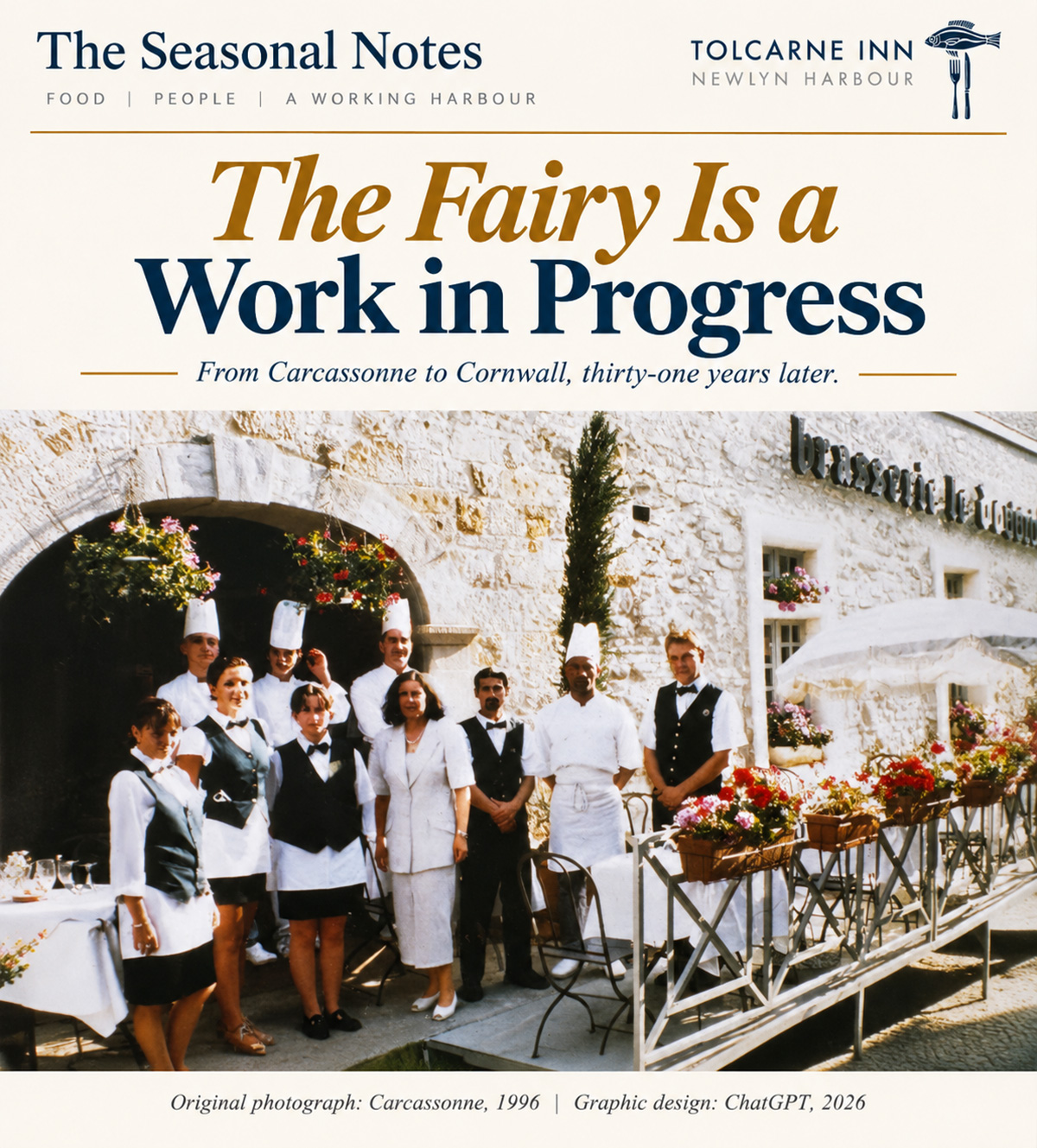
When I was nineteen, I travelled from Poland to France for a work placement. It was quite an adventure: a different country, a different language and a world beyond the one I knew.
In the medieval town of Carcassonne, I met a woman who made quite an impression on me.
Her name was Madame Pigout.
She ran the restaurant where I was working. Intelligent, hardworking, beautifully dressed, she possessed the sort of authority that required no announcement.
Oh, those skirts!
Magnificent, sweeping creations entirely unsuitable for carrying boxes, scrubbing floors or wrestling with industrial cleaning equipment.
Not that I ever saw Madame Pigout doing any of those things.
She had people.
And those people knew when she was around.
The restaurant was relentlessly busy. Preparations were frantic, everyone had a hundred things to do, and then Madame Pigout would appear.
Suddenly, everyone developed an extraordinary ability to become invisible.
Everyone except the head chef, who appeared to enjoy diplomatic immunity.
I was a little frightened of her. But fascinated, too.
She could command a room simply by walking into it. Later, she would take her place near the entrance, charm the customers and collect the money. In fact, that was the only job I ever saw her doing.
To a nineteen-year-old finding her feet in a new country, she was extraordinary. I admired her confidence and independence. I decided that one day I would be rather like her.
Thirty-one years later, I can report mixed results.
The skirts? Acquired.
The authority? Occasionally exercised.
The people? There have been plenty.
The job description? Nothing like the one I imagined.
Somewhere between the magnificent skirts and the elegant supervision of a restaurant, I discovered a career path nobody had thought to mention. Apparently, it involved becoming a fairy.
Not the glamorous kind.
The practical variety.
The sort who notices wilting flowers, disappearing cleaning products, salt-covered windows and things put away where nobody will find them.
Sometimes by me.
I can reorganise a cupboard so efficiently that I lose everything in it. Fortunately, I have a solution: another reorganisation.
Over the years, I’ve developed systems: newsletters, management meetings, appraisals, checklists and ways of encouraging communication before minor disagreements become international incidents.
At one point, there were sixty people to organise. I was in my element.
I loved identifying problems, inventing solutions and watching them work. Unfortunately, people introduce unexpected variables.
One memorable invention was a thumbs-up, thumbs-down feedback system.
Simple. Democratic. Surprisingly effective.
There was one complication: every thumbs-down required an investigation.
By me.
I had invented a system that generated more work for its inventor.
The Management Department declared success. The Fairy Department requested additional staffing.
The request was declined.
Systems are useful, but they cannot entirely overcome human nature. Including mine.
I encourage consistency, then forget where I’ve put my paperwork. Occasionally, the paperwork and I have a disciplinary meeting. Neither party accepts responsibility.
Objects and buildings resist management, too. Rubbish swept into a neat corner awaits ceremonial collection. Cupboards develop independent organisational philosophies. Cobwebs pursue ambitious expansion strategies.
The spiders are particularly persistent. They occupy Tolcarne, my house and, I suspect, every old building in Cornwall. I remove their handiwork; they replace it overnight. Neither side is interested in compromise.
But the most challenging member of the team is the building itself.
Over three hundred years old, Tolcarne has no interest in modern management principles. The walls are wonky, the floors have their own ideas, and the wallpaper occasionally reveals that the structure behind it has been pursuing alternative plans.
I’d love to summon Time to a meeting and negotiate terms before authorising further deterioration.
Preferably in writing.
Time has ignored my correspondence.
Yet without its imperfections, Tolcarne wouldn’t be Tolcarne. I simply wish it would cooperate occasionally.
I can forgive a three-hundred-year-old building. People, however, are occasionally held to slightly higher standards.
And that’s when the fairy becomes a witch.
Usually after something has been discussed, agreed, written down, demonstrated and promptly forgotten.
The eyebrows become involved. The atmosphere changes. And inside her head comes the announcement:
Right. I’m going to sort this out.
Unlike the fairy, the witch isn’t interested in encouraging personal development. She wants to know why the job hasn’t been done.
Her broomstick isn’t for flying. It’s for sweeping up whatever everybody else has failed to notice.
Occasionally, she discovers that the offending item was misplaced by the fairy herself.
An unfortunate development.
The witch prefers not to discuss it.
Fortunately, she rarely stays in charge for long. The fairy returns, sometimes with an apology, often with another idea, wondering whether the episode required quite so much fuss.
The trouble with being both fairy and witch is that neither knows when to clock off.
In earlier years, I threw enormous energy at every problem. Another system, another procedure, another meeting.
I loved it.
Actually, I still do.
But these days, I’m a somewhat less permanent fairy. Other people take care of things that once required my attention, and I’m grateful. I still notice things, have ideas and occasionally reorganise the cleaning cupboard into a functioning department.
Then I go home.
This is progress. Particularly when I resist returning the following morning to check whether the department is still functioning.
Some of my inventions have even survived long enough to become useful. The regular newsletters, for example, have finally put an end to the great mystery of next month’s opening hours. A small miracle, considering how many years it took to achieve.
But one of my favourite measures of success has little to do with cupboards or checklists. It’s seeing familiar faces return, welcoming new ones, and meeting people who’ve lived around the corner for years but somehow never knew we existed.
The pleasure is in knowing that what we’ve created matters to people. And in those rare moments when everything is just as it should be, I can leave it that way for a little longer.
I wonder whether Madame Pigout ever knew how much she inspired that nineteen-year-old girl.
Probably not.
Perhaps somebody remembers an idea, a conversation, a little encouragement or one of my enthusiastic organisational interventions. Perhaps I’ve inspired someone without knowing it.
I’d rather like that.
The fairy still cares as much as ever. She’s simply become more selective about how much energy she invests.
And perhaps, after all these years, I’m not quite so far from becoming Madame Pigout as I once imagined.
I have the skirts.
I can look glamorous when required.
I have people.
I have ideas.
And I can even trust others to collect the money for me.
On a good day, I can walk into Tolcarne, look around and think:
Actually, it’s not that bad.
Which, coming from the fairy, is practically a five-star review.
Now… where did I put my duster?